
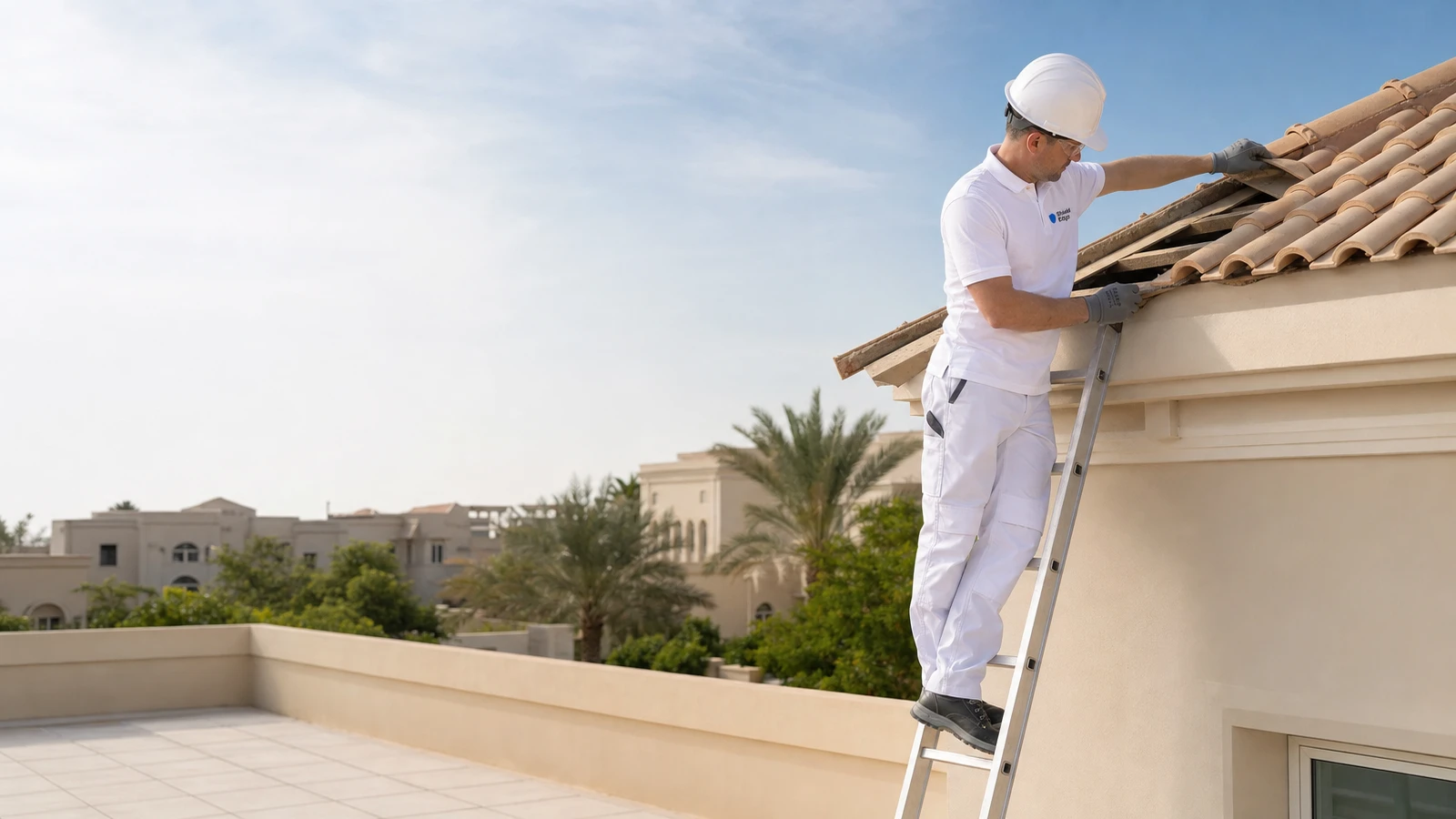
Roof Waterproofing in The Springs and The Meadows
Pitched tile roofs now around two decades old, where the real barrier sits under the tiles and has hardened with age.
Roof leaking in Springs or Meadows? Let’s talk.
How a Springs or Meadows roof is actually built
These are sloped roofs finished in tiles, and the build-up is simpler than a flat roof but just as misunderstood. From the ceiling upwards it runs roughly like this:
- The roof structure.
- A sheet membrane laid across it. This is the waterproofing.
- Battens fixed over the sheet.
- The clay or concrete tiles you can see from the street.
The tiles are a rain screen. Their job is to throw most of the water off the roof and to shade the sheet below from ultraviolet light, which would destroy it in a couple of summers if it were exposed. The sheet is what actually keeps water out of the house, and it depends on the tiles staying where they were put.
These are among the earliest Emaar communities in Dubai, so a great many of these roofs are now around two decades old. Twenty years is long enough for a sheet layer to harden and lose its flexibility, and long enough for fixings to work loose. Neither is visible from the ground.
Most of these villas also have a small flat area behind or beside the pitch, carrying the tank and the AC condenser. It is usually treated as an afterthought by whoever last worked up there, and it is built like a miniature version of the flat roofs found elsewhere in Dubai, with the waterproofing buried beneath a screed and a finish.
The three places Springs and Meadows roofs leak
1. Ridges, hips and the abutments against walls
Water is concentrated wherever two planes of roof meet, and wherever the roof runs into a vertical wall. Those lines carry far more water per metre than the open field of tiles does, and they depend on a detail rather than on gravity. They are the first place we look and the most common thing we find.
2. The aged sheet under the tiles
This is the real failure in these communities, and it is invisible from anywhere you can stand. A sheet that has hardened no longer moves with the roof, so it splits at the points of greatest movement. Water then travels along the top of it, sometimes several metres, before finding a gap and dropping through. The stain on your ceiling marks where the water came out, not where it came in.
3. The small flat section behind the pitch
A tank platform or condenser area a few square metres in size, with three or four penetrations crowded into it and a parapet on two sides. Proportionally it has more detailing per square metre than any other part of the roof, and it receives almost no attention.
Why tracing the leak matters more here than anywhere else
On a flat roof, water broadly enters near where it shows. On a pitched roof it does not. It gets under the tiles at one point, runs down the slope of the sheet, and drops into the house wherever it encounters a split or a fixing hole. We have seen entry points several metres up-slope from the stain and on the opposite side of a room.
This is why patching the ceiling side, or resealing directly above the stain, fails so reliably here. We cover the same pattern in our guide on what a ceiling stain actually tells you. The fix has to start at the entry point, and finding it is a diagnostic job rather than a guess.
How we work in The Springs and The Meadows
Every job starts with a free inspection, and the inspection is a real diagnosis rather than a man with a clipboard writing down a rate. We look at the roof as a system: access and safety first, then the overall slope and where water has been sitting, then the parapet, the movement joints and every pipe, cable and AC unit passing through the surface.
We take moisture readings across the roof, photograph every joint, drain, flashing and penetration, use thermal imaging where conditions allow, and run a flood test where the evidence calls for one. You get a written report: what is wrong and where, tied to photographs and actual readings, what is required against what is merely optional, the system we propose and the reasoning behind it, and a fixed price.
Where the membrane is otherwise sound, we recommend a spot repair rather than a full replacement. That is a stated policy, and it costs us money every time we apply it, because the full job bills more. Roof waterproofing and heatproofing carry our 10-year workmanship warranty, and keeping it active takes one short check-in a year at no cost.
What roof waterproofing costs in The Springs and The Meadows
Roof waterproofing and heatproofing is AED 130 to 390 per square metre, depending on the condition of the roof and the system specified. The low end assumes a sound existing surface and a straightforward overlay. The high end covers a full strip-out, slope and screed correction, and a premium multi-coat system.
Pitched roof work is priced on what the sheet layer and the details need, not on a coating area, which is why nobody can honestly quote one of these over the phone. A villa needing the ridge line and one abutment reworked is a modest job. A villa whose sheet has gone brittle across the whole roof is a much larger one, and the difference between the two is not visible until someone lifts tiles and looks.
We publish that range rather than keeping it private, because the gap between a cheap quote and a specified system is the thing most owners in The Springs and The Meadows are trying to understand. If you have quotes in front of you now, why one quote says AED 40 per m² and another says AED 300 explains what each price actually buys. Full details are on our pricing page, and we do not quote without inspecting first.
Common questions
Can you waterproof a tiled roof by coating the tiles?
No. The tiles are a rain screen, and the waterproofing is a sheet membrane underneath them. A coating applied over tiles sits on the wrong side of the problem entirely. It also traps water that gets past a cracked tile, which can make matters worse rather than better.
My neighbour in the same Springs cluster had a leak. Should I be worried?
It is worth an inspection. These villas were built to the same design at the same time, so the detail that failed on their roof exists in the same place on yours and is the same age. That does not mean yours has failed, but it is the cheapest possible time to find out.
The stain is in the middle of my bedroom ceiling. Is the hole directly above it?
Very unlikely on a pitched roof. Water gets under the tiles higher up, runs down the sheet below them, and drops through at the first split or fixing hole it reaches. The entry point is often several metres away. Sealing above the stain is why so many of these repairs are done twice.
Do I need to replace all the tiles?
Usually not. Tiles are durable and individual ones can be reset or replaced. The work that matters is on the layer beneath them and at the ridges, hips and abutments. If someone quotes you a full re-tile without lifting a tile to look underneath, ask what they are basing it on.
Book a free roof inspection in The Springs and The Meadows
Send a message on WhatsApp, or book through the Request an Inspection page. We will tell you what your roof needs, including when the honest answer is that it needs very little.
Worth reading first: the system we actually install, and what it costs.
We also carry out roof waterproofing and leak repair across the rest of Dubai, including Arabian Ranches, Jumeirah Park, Emirates Hills. Every community we cover is listed on our areas page.