
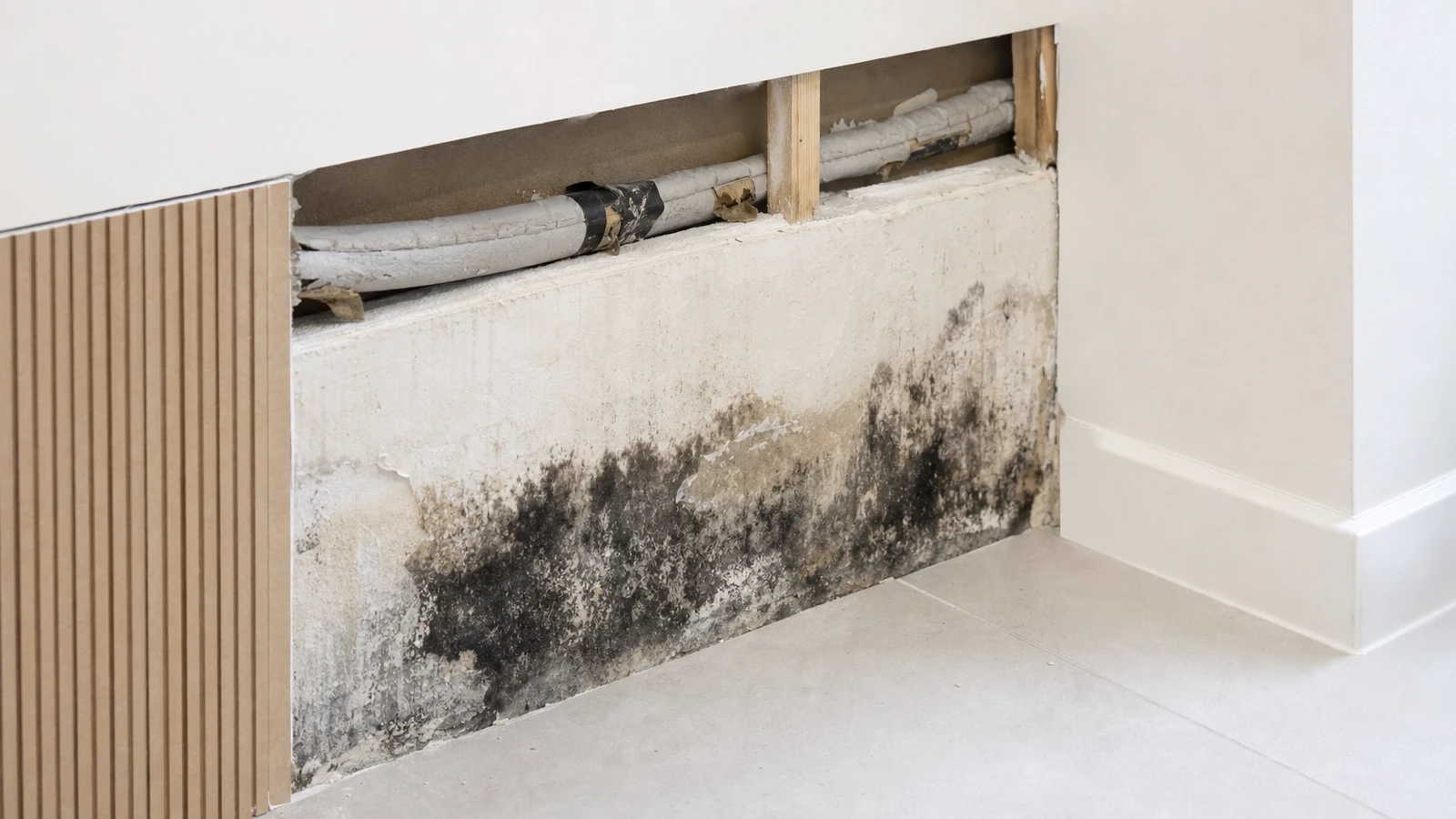
Mould is not the problem. It is the evidence. By the time you can see it on a wall, something has been quietly wetting that wall for weeks or months, and the useful question is not how to remove the mould. It is what has been keeping the wall wet.
That distinction matters because it decides whether you pay for this once or every year. Clean the wall and the mould goes. Leave the water and it comes back, in the same place, usually by the end of the next summer.
The short answer
In the properties we inspect across Dubai, mould on a wall almost always traces back to one of four things:
- Leaking or poorly insulated air conditioning pipework, which is the most common of the four.
- A roof leak that has entered the slab and travelled before coming out.
- Condensation forming on a cold surface in humid air.
- A slow plumbing leak inside the wall or behind a fitting.
Each one leaves a different pattern, and the pattern is what tells you which you have.
Where the water is actually coming from
Leaking or uninsulated AC pipework
Chilled water and refrigerant pipework runs cold. In Dubai’s humidity, any section where the insulation has been stripped, crushed or never properly fitted will sweat, and the water runs down the pipe to the lowest point it can reach. That is frequently inside a wall or a ceiling void, where nobody sees it until the wall tells them.
On an apartment we quoted in Jumeirah Lakes Towers the mould on the walls and inside the built-in furniture came from exactly this: leaking AC pipework with insulation missing in the hard-to-reach sections. The scope was never really a mould job. It was a pipework job with mould treatment attached, and we deliberately quoted it that way, because treating the mould while leaving the leak would have been money thrown at a symptom.
The tell: mould that is present through the summer regardless of whether it has rained, near an AC unit, along a pipe run, or in a wardrobe backing onto one.
A roof leak that has travelled
Water entering through a crack or a failed joint in the roof does not drop straight down. It gets into the floor slab and moves along it, exiting wherever it finds a route out. That is why the damp patch is so often nowhere near the defect, and why patching the roof directly above a stain so frequently fails. We have written separately about the common causes of roof leaks in Dubai.
The tell: mould high on the wall or in the corner where wall meets ceiling, worse after rain, often with staining that spreads outward rather than running down.
Condensation on a cold surface
Warm humid air meeting a cold surface deposits water on it. In a Dubai summer that can be an uninsulated section of wall, the back of a wardrobe pushed flat against an external wall, or a room that is air conditioned hard while the space next door is not. No leak exists at all; the building is simply making water out of the air.
The tell: mould in a corner or behind furniture, on external walls, with no plumbing or AC pipework anywhere near it.
A slow plumbing leak
A weeping joint behind a wall or under a shower tray produces a small, constant supply of water with no visible drip. It is the least common of the four in our experience, but it is the one that does the most structural damage before it is found, because nothing above the floor suggests anything is wrong.
The tell: mould low on a wall, near a bathroom or kitchen, present year round and indifferent to the weather.
Why it comes back after you clean it
Cleaning removes the growth and leaves the moisture. Mould establishes on a damp surface, so for as long as that surface is being wetted it will re-establish, and it will do it in the same place because the water has not moved.
If mould has returned twice in the same spot, stop buying cleaner. Two returns is enough evidence that the problem is a water source, and the only thing that changes the outcome is finding it.
What is usually behind the panelling
On a villa we quoted in Umm Suqeim, the mould was behind MDF wall panelling. Nothing was visible in the room beyond a faint smell and some discolouration at the edge of a panel. The wall behind it was a different matter.
This is the ordinary case rather than the dramatic one. Panelling, built-in wardrobes and boxed-in pipework all create a still, unventilated cavity against a wall. If anything wets that wall, the cavity holds the moisture and nothing dries. By the time it reaches the face of the panel, the area behind is considerably larger than what you can see.
Why no one should quote a fixed price before opening the wall
When we price mould work we give a rate per square metre and an estimate of the area, and we say plainly that it is an estimate. The rate is settled. The area is not, and the area decides the cost. On the Umm Suqeim villa the difference between the likely cases was several tens of thousands of dirhams, and no honest number existed until a panel came off.
If a contractor gives you a fixed price for mould treatment before anyone has opened the wall, they have either guessed high to protect themselves or guessed low to win the job. The second one gets corrected later, at your expense, once the work has started and you have no leverage.
What to do first
- Photograph it, including a wide shot that shows where in the room it sits.
- Note whether it is worse after rain, or constant through the summer. That single observation separates a roof problem from an AC or condensation problem faster than anything else.
- Check whether anything is boxed in or panelled nearby, and whether furniture sits flat against that wall.
- Do not repaint over it. Paint hides the evidence and buys a few weeks.
- Get the water source identified before paying anyone to treat the surface.
You may also see this written as mold rather than mould. It is the same thing, and the diagnosis is the same either way.
Where we fit
We treat mould as part of fixing what caused it. If the source is AC pipework the work sits with AC support; if it is the roof, with roof waterproofing and leak repair. In both cases the mould treatment is a line in a larger scope rather than the job itself, because that is the only version that stops it coming back.
If you are not sure which of the four you are looking at, free inspection is the starting point and it costs nothing. We will also tell you when the answer is that the problem is small and does not need us.
Related reading: roof leak or AC condensation, and what a ceiling water stain is telling you.
Common questions
What causes mould on walls in Dubai?
Something has been keeping the wall wet. In our experience the four usual sources are leaking or poorly insulated air conditioning pipework, a roof leak that has travelled through the slab, condensation forming on a cold surface in humid air, and a slow plumbing leak inside the wall. Mould is the visible result, not the cause, which is why cleaning it off without finding the water source does not work.
Why does mould keep coming back after I clean it?
Because cleaning removes the growth and leaves the moisture. Mould needs a damp surface to establish, so as long as the wall is still being wetted it will return, usually in the same place and usually within weeks. If mould has come back twice in the same spot, the useful next step is finding the water, not buying a stronger cleaner.
Is mould on a wall a roof problem or an AC problem?
Both are common and they look different. Mould high on a wall or where the wall meets the ceiling, worse after rain, points towards water entering from above. Mould near an AC unit, along a pipe run or inside a built-in wardrobe, present all summer regardless of rain, points towards condensation or leaking pipework. An inspection establishes which, because the repair is completely different.
Can you give me a fixed price to treat mould?
Not before a panel or a section of wall comes off. The rate per square metre is settled but the affected area is not, and the area decides the cost. We quote mould work as an estimate, inspect, then convert it to a fixed price. Anyone offering a fixed price for mould treatment before opening the wall is guessing, and the guess gets corrected later at your expense.
Do you offer mould inspections in Dubai?
Yes, as part of a leak and damp inspection rather than as a separate service. We look for the water source first, because treating mould without fixing what is wetting the wall means paying for the same work twice. The inspection is free and we will tell you if the honest answer is that the problem is small.