
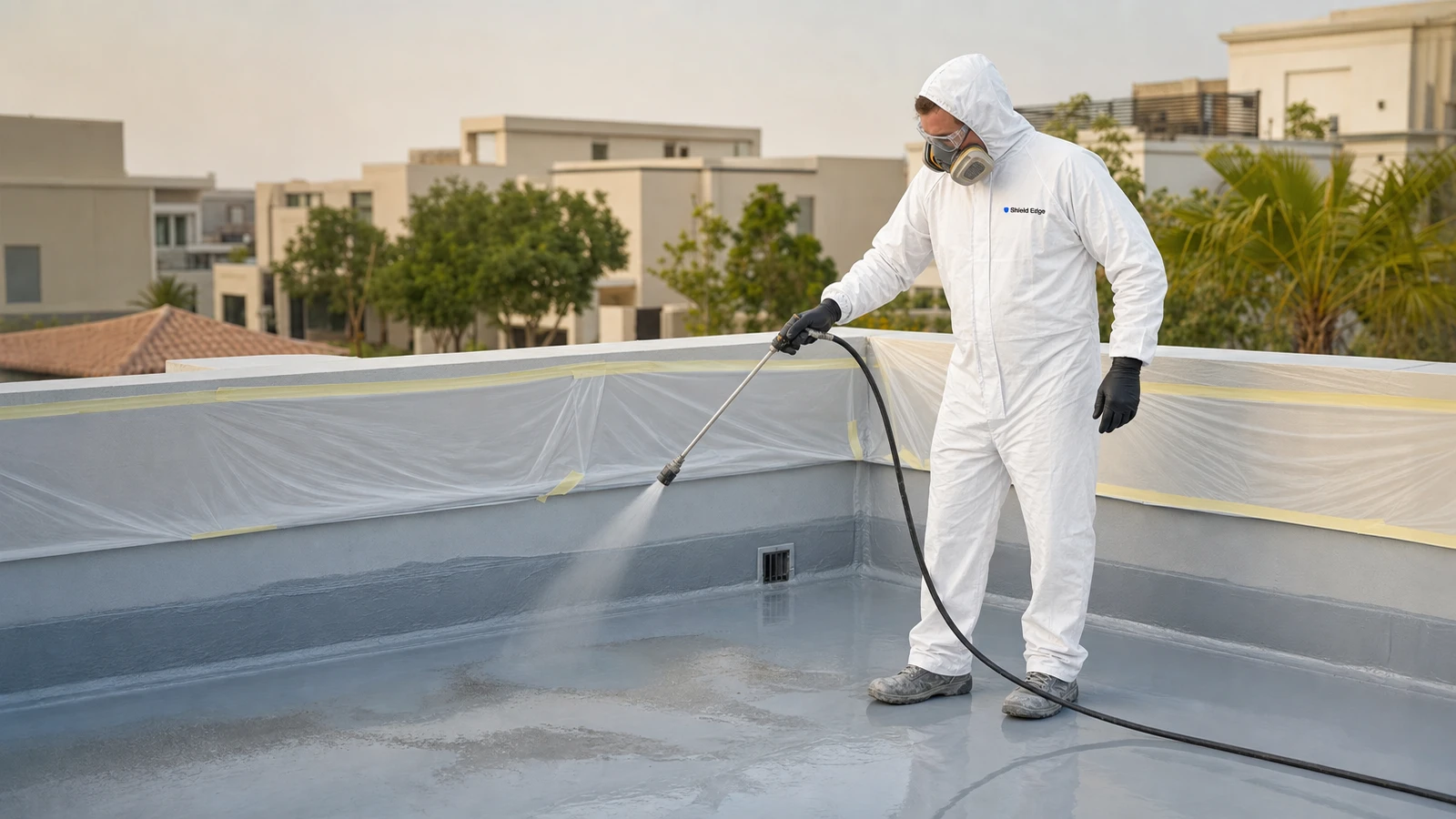
The best waterproofing solution for a Dubai villa is the one that matches the roof you already have. For most flat villa roofs here that is a silicone liquid system over a properly prepared surface. For an older pitched tile roof it usually is not a coating at all. What decides it is the condition of the roof, not the name of the product.
That answer frustrates people who want a single product name, so this guide sets out the five questions that actually decide it, in the order a villa owner runs into them.
1. What is already on your roof, and what does that rule out?
Two villas a few streets apart can need completely different work. Before anyone talks about products, you need to know which of these you own.
- A flat concrete roof. The most common villa roof in Dubai. Under your feet there is usually a concrete slab, a sloping layer of sand and cement to push water towards the drains, called the screed, then a waterproofing layer, then sometimes tiles or gravel on top. Liquid coatings suit this roof.
- A pitched tile roof. Common in the earlier Emaar communities such as The Springs, The Meadows and The Lakes. The tiles are not the waterproofing. The real barrier is a sheet underneath them, and when water gets in on these roofs it is usually because that sheet has aged or tiles have shifted. Painting the tiles does not fix it.
- A mix of both. Plenty of villas have a flat roof area for the water tanks and AC units, with pitched tile sections over the bedrooms. They often need two different answers on the same house.
Then there is the second half of the question, which people forget: what has already been done up there. Many Dubai villa roofs carry two or three old coatings, each applied over the last one by a different contractor. Every layer changes what can be done next, because a new system has to bond to what it lands on.
You can learn a lot from the ground and a phone camera on a selfie stick, but if you do go up, go in the early morning, keep away from the edges, and do not walk on a roof you suspect is damp underneath. What you are looking for is simple enough: tiles or gravel loose on a flat roof, a coating that has gone chalky or is peeling at the edges, cracks in the low wall running around the roof, called the parapet, and dark patches that stay dark after everything else has dried.
2. Silicone, polyurethane, acrylic or a sheet membrane?
A Dubai villa roof has to survive four things, and they are not the four things a European roof deals with.
- Water that sits. We get roughly 68mm of rain a year across about 12 to 13 rainy days, so the roof is dry most of the time. The problem is what happens on those days. Drainage on villa roofs here was designed for sun, not water, so rain often stands in low spots for days. In April 2024 a single day delivered around 160mm, the heaviest in about 75 years, and roofs that had never been tested were tested all at once.
- Heat. Surfaces run well past the 45°C air temperature in summer. The roof expands all day and contracts all night, every day, for years.
- UV. Constant, strong, and the main reason cheap coatings age far faster here than their rated life suggests.
- Sand. It blocks drains, it scours surfaces, and it ruins the bond if the roof is not properly cleaned before anything is applied.
Against those four, here is how the options actually behave.
Silicone
Our preferred system for most Dubai flat roofs. It handles standing water, which is the one property that matters most here, and it stays flexible through years of heat cycling instead of going brittle. It costs more than acrylic, and it will not forgive a dirty or poorly prepared surface, because it needs a clean substrate to bond to.
Acrylic
The cheap default across Dubai, and the reason so many villa owners are on their third repair. It reflects heat well, which is genuinely useful, but it does not hold up under sustained UV here. The typical failure is fine cracking across the surface, well before the rated life is up, and it does not like water sitting on it. If a quote is unusually cheap, this is usually what is in it.
Polyurethane
The toughest of the three underfoot. It belongs where people and equipment are regularly on the roof, such as commercial buildings and plant rooms. On a villa it is usually overkill and overpriced, and we will tell you so. The exception is a roof deck you actually use, or a busy area around water tanks and AC units that gets walked on for servicing.
Sheet membranes
Rolls of material bonded down in overlapping strips rather than a liquid brushed or sprayed on. They are a sound system, and they are what sits under the tiles on a pitched roof. On a flat villa roof the weak point is the joins, and the more pipes, corners and upstands a roof has, the more joins there are to get right. A liquid system goes over an awkward roof in one continuous piece with no seams, which is why we usually favour it on villas.
Whatever the system, the brand behind it should be one that will honour a materials claim. We use manufacturer-backed systems from Sika, Fosroc, MAPEI, Dow and Tengyu. That matters on the day something goes wrong, not on the day it is applied.
One thing to be clear about before you buy anything: make sure you are fixing a roof problem. Water appearing after a hot, dry day with the AC running is usually not the roof at all, and no coating will stop it. Our guide on telling roof leakage from AC condensation covers how to separate the two, and what a ceiling stain is actually telling you goes wider than that.
3. Can it go over the old system, or does that have to come off?
This question moves a villa quote further than any product choice does. Going over what is there is far cheaper than stripping back to the concrete, correcting the falls and starting again. It is also the decision most often got wrong, in both directions.
You can usually coat over an existing system when it is still stuck down across the whole roof, is dry underneath, has no trapped moisture, and is compatible with what is going on top. You cannot when any of the following are true.
- The old layer is lifting. Anything applied over a coating that is letting go will let go with it.
- There is water trapped underneath. Seal wet layers in and the water stays, moves sideways and comes out somewhere else. Blisters and soft spots are the giveaway, and a moisture meter confirms it.
- Water sits in the same places every time. If rain ponds because the slope is wrong or the drains are in the wrong place, another coating does not fix the slope. The sloping layer beneath has to be corrected first.
- There are too many old layers. At some point the build-up is a stack of failures rather than a base to work from.
This is what a survey is for, and it should produce actual readings rather than an opinion. On our inspections that means moisture readings on every suspect area, photographs of every joint, drain and pipe, thermal imaging where conditions allow, and a flood test where one is warranted. You can see what that should look like in our guide to what an honest roof inspection involves.
It is also where the price range comes from. We publish our pricing at AED 130 to 390 per square metre. The bottom of that range is a sound roof taking a straightforward overlay. The top is a full strip-out with slope correction and a premium multi-coat system. Two identical looking villas can sit at opposite ends, which is exactly why one quote says AED 40 per square metre and another says AED 300. If you want the arithmetic in full, our cost guide breaks down what sits behind each line.
A worked example. A Jumeirah Park villa of about 15 years old came to us with cracking across the roof and no waterproofing membrane ever installed, only a failing acrylic coating on a roof that had never been cleaned. That needed a full clean, crack repair and a silicone system: around 100 square metres, roughly AED 32,000, five days on site. It has been under annual warranty checks since with no callbacks. A different roof of the same size, in better condition, would not have cost that.
4. Should waterproofing and heatproofing be one job or two?
One visit, two different properties. Keeping water out and keeping heat out are not the same thing, and a product that does one does not automatically do the other.
- Waterproofing is about the barrier: is it continuous, is it stuck down, does it survive standing water and movement.
- Heatproofing is mostly about reflectivity: a pale, reflective surface sends sunlight back instead of letting the roof soak it up, so the slab underneath runs cooler.
The practical point for a villa owner is timing. The expensive parts of a roof job are the access, the cleaning and the preparation, and those are the same whether you are doing one or both. Deciding to add heatproofing two summers later means paying for all of that again. If the upstairs bedrooms are unbearable in August and the roof is being redone anyway, do it in the same visit.
Be realistic about what it does, though. A reflective roof lowers the heat load coming through the ceiling. It does not compensate for thin insulation, west-facing glazing with no shading, or an undersized AC unit. If your upstairs is hot and the roof is sound, the roof may not be the thing to spend money on, and we will say that after looking.
5. Why does the same product last three years on one villa and ten on another?
Because the product is maybe a third of the outcome. The rest is what happened before and around it, and this is the real answer to which solution is best.
- Preparation. A roof that has never been cleaned is carrying years of dust bonded to the surface. Coat over that and you have bonded the new system to the dirt, not the roof.
- The details. Most leakage does not start in the open middle of a roof. It starts where the roof meets something else: the low parapet wall, the pipes and cable runs passing through, the AC unit plinths, the drain outlets. Waterproofing has to carry up those vertical surfaces and be finished off properly. Skipping detail work is the fastest way to a roof that looks perfect and leaks anyway.
- Thickness and coats. The same product applied thin is a different product in practice. A system is specified as a number of coats reaching a certain thickness, and thinning it out to cover more area is a silent way to cut a price.
- Drying time between coats. Rushing a roof to finish on a Thursday traps solvent and moisture between layers. It fails from the inside out and nobody can see it happening.
- Drainage. A blocked outlet turns a functioning roof into a shallow pond. This is the cheapest thing on the list to get right and the most commonly ignored.
We wrote about the mechanics of this in why roof repairs in Dubai keep failing, and the correct sequence in how to waterproof a roof in Dubai. Both are worth ten minutes before you sign anything.
It is also why the warranty matters more than the brochure. Ours is a 10-year workmanship warranty on roof waterproofing and heatproofing, and the cover does not shrink over time: year one and year ten are treated the same. It stays active with one annual check-in, which is a short visual inspection or photographs you send us, at no cost. It covers workmanship, while materials carry their own manufacturer warranties, and we help claim against those if a material defect is at fault. Before you compare any two warranties, read what the fine print usually hides, because a 25-year promise from a company with no service record is worth less than a 10-year one that gets honoured.
So what is the best solution for your villa?
Put simply.
- Flat concrete roof, sound surface, water drains away. A silicone liquid system over a properly cleaned and repaired roof. This is the common case and it sits at the lower end of the price range.
- Flat roof with water standing in the same spots. Fix the slope and the drainage first, then waterproof. Coating over ponding is money spent twice.
- Flat roof with trapped moisture or several failed layers. Strip back, repair the substrate, then a specified multi-coat system. This is the expensive end, and it is the end where cheap quotes do the most damage.
- Pitched tile roof. Repair or replace the sheet layer under the tiles and sort out the flashings and ridges. Do not let anyone paint your tiles and call it waterproofing.
- Isolated leakage on an otherwise sound roof. Find the actual entry point and treat that. We recommend a spot repair over a full replacement whenever the membrane is otherwise sound, even though a full job bills more.
That last one is worth dwelling on. A homeowner came to us with a recurring stain on a bathroom ceiling. Several contractors before us had each patched the roof directly above the stain, and the leakage came back every time. The actual entry point was several metres away, with water travelling under the membrane and in places through the slab. We sealed that one point, confirmed it with a flood test, and left the rest of the roof alone. It stopped.
The best waterproofing solution is the one specified after somebody has been on your roof with a moisture meter and a camera. Anyone who quotes a villa roof over the phone is guessing, and you will pay for the guess.
Getting a straight answer on your roof
Our inspection is free, and the report is a diagnosis rather than a one-line quote: what is wrong, where, with photographs and moisture readings, what is required against what is optional, the system we propose and why, and a fixed price. If the honest answer is that you need a repair rather than a new roof, that is what the report will say.
Message us on WhatsApp on +971 54 730 9500, or book through the Request an Inspection page. If your villa is rented, or you are not sure whether this is your bill at all, read who actually pays for roof leakage in Dubai first.
Our roof waterproofing and heatproofing rates are published in full on our pricing page, including what sits at each end of the AED 130 to 390 per square metre range.