
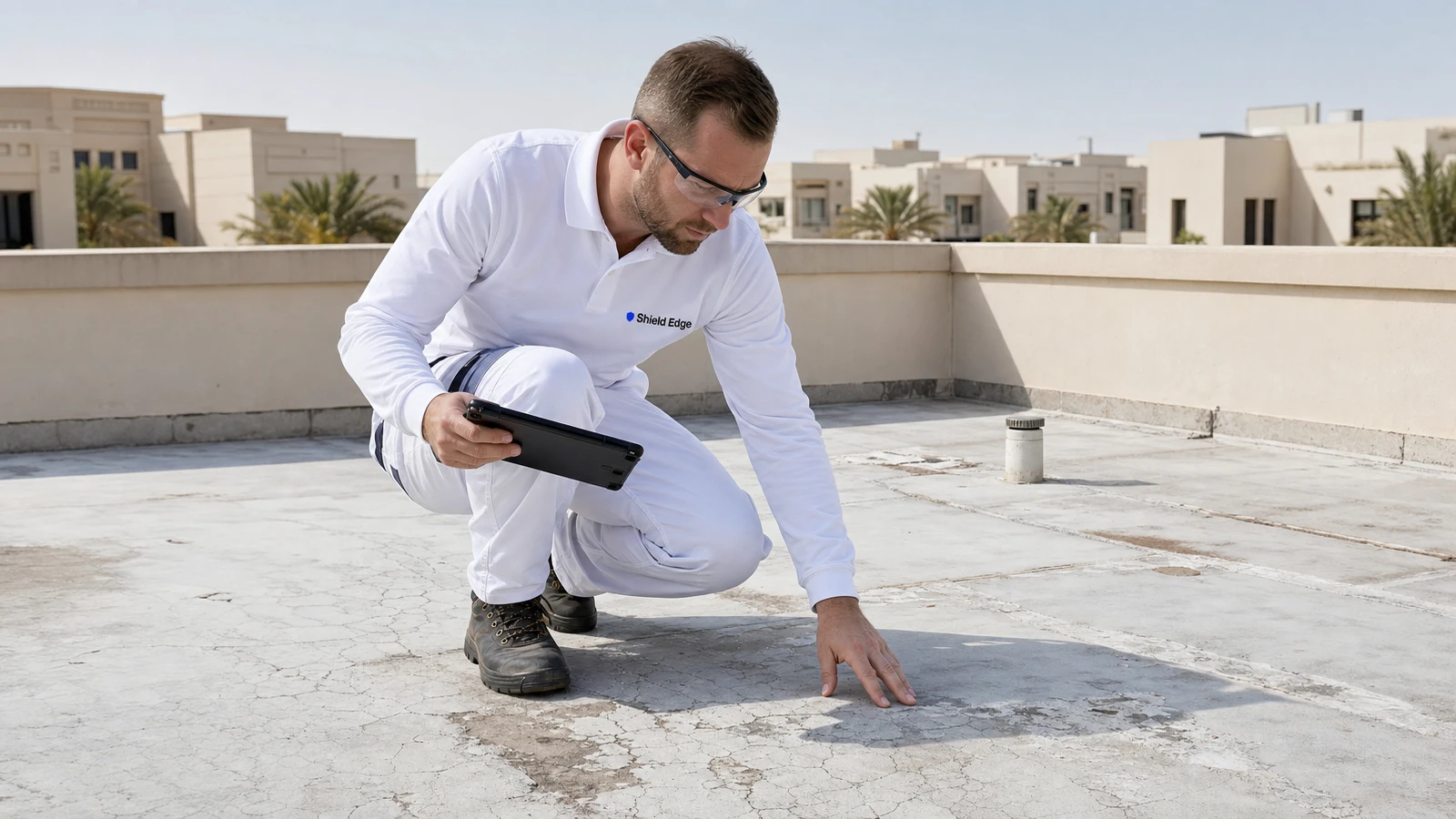
Most roof inspections in Dubai follow the same script. A technician climbs up, looks at the ceiling stain the owner mentioned, and comes back down with a quote for a full waterproofing job. Fast, simple, and usually wrong.
Here’s what happens during one of our inspections, and where we see most companies cut corners.
The shortcut that costs homeowners the most
The most damaging habit in this industry is heading straight for the visible damage. A crew shows up, sees the stain on the ceiling, and tells the owner the whole roof needs redoing.
Many don’t properly check the drains, joints, and penetrations, don’t bring a moisture meter, they just look at the stain and jump to conclusions. The client pays for full waterproofing, and a year or so later the leak comes back, because nobody ever found the actual source.
The stain shows where water happened to come out. It almost never shows where the water got in.
What we do in the first five minutes
Before we start hunting for the leak, we look at the roof as a whole system. Safety and access first, then the overall slope, then the marks left by standing water that stick around even after everything else has dried.
From there we go over the parapets, the expansion joints, and every penetration: the points where pipes, cables, and AC units pass through. That order isn’t arbitrary. Water rarely leaks straight down; in most cases it enters at one point, runs under the membrane, and surfaces somewhere else entirely. Go straight for the stain and there’s a good chance you patch the wrong spot.
Even when a homeowner just wants us to “look at the wet patch,” we don’t shorten the process. We bring a moisture meter every time, and we photograph every joint, drain, flashing, and penetration. We use a thermal camera when conditions allow. Just looking with your eyes isn’t an inspection, that’s guessing. We come to diagnose, not to confirm what’s already visible.
A leak that wasn’t where it looked like it was
One case shows why the order matters. A homeowner had a recurring stain on the bathroom ceiling and had already called out a few different crews. Each one patched the area directly above the stain. Each time, the leak came back.
We found the real entry point several meters away. Water was traveling under the membrane, and in places through the slab itself, before surfacing at the stain. We sealed that entry point and tested it with a flood test, and the leak stopped for good. We didn’t touch the rest of the roof.
The difference between alarming and serious
Homeowners tend to flag the wrong things. Old dirt stains, white mineral deposits on the surface, small surface cracks, old patches that look rough but have quietly held for years: these usually look worse than they are.
What deserves attention is quieter: a thin crack where a parapet meets the roof deck, sealant that’s just starting to lift around a pipe or AC unit, faint pooling marks near a drain. Those small, easy-to-miss details are behind most of the real leaks in Dubai.
What a free inspection can tell you, and where it stops
A good inspection, free or not, can pinpoint where water is entering, check key points with a moisture meter, and work out whether a spot repair covers it or the job needs to go further. That’s a real diagnosis.
What it can’t fully confirm without extra steps is the condition of the membrane across the whole roof, or how the system holds up under sustained heavy rain. For that we sometimes need a test opening or a flood test. We’re always honest about where the limits of a visual inspection are.
Why we sometimes recommend the smaller job
When a leak is localized and the rest of the membrane is in reasonable shape, we recommend spot repair, even if a full waterproofing job would bring in more revenue for us. The logic is straightforward: a client we honestly saved money for comes back, and brings their neighbors with them. A client we sold a full roof they didn’t need usually doesn’t call again.
The one question worth asking
Most people jump straight to “how much to redo the whole roof?” The better question is where the water is getting in and where it travels before it shows up as a stain. Ask that, and we know immediately we’re talking to someone who understands the problem. It tends to make the whole job go smoother for both sides.
Villa, warehouse, or commercial roof
A villa inspection is a precision job. There’s a lot to check in a small area: AC units, pipes, parapets, decorative elements. A warehouse inspection is about scale: slope and drainage across a large surface, where one weak zone can end up collecting runoff from hundreds of square meters. A commercial building adds a logistics problem on top: limited access, tenant schedules to work around. Our method doesn’t change across the three. Where our attention goes does.
What belongs in our report
We don’t hand over a one-line quote. Our report includes an exact description of every issue found, tied to photos and specific locations, the actual moisture meter readings, and a clear recommendation on what’s required versus optional: spot repair or a full system job, and why. We also list the materials we’re proposing and the reasoning behind them, plus either a fixed price or clearly defined terms for what happens if the scope changes. The point is to close off any conversation that starts with “we thought that was included.”
The failure that’s almost always preventable
Blocked drains, deteriorated expansion joints, and failed penetrations cause most of the roof problems we see, and they’re also the easiest to catch early. Left alone for two or three years, water ends up traveling under the membrane long before anyone notices, and by the time it does, the repair costs far more than it would have. Most of the serious roof leaks in Dubai could have been caught, and avoided, by a proper inspection two years earlier.
If you want the numbers before you book anything, our pricing page lists our roof rates and what each one includes.